

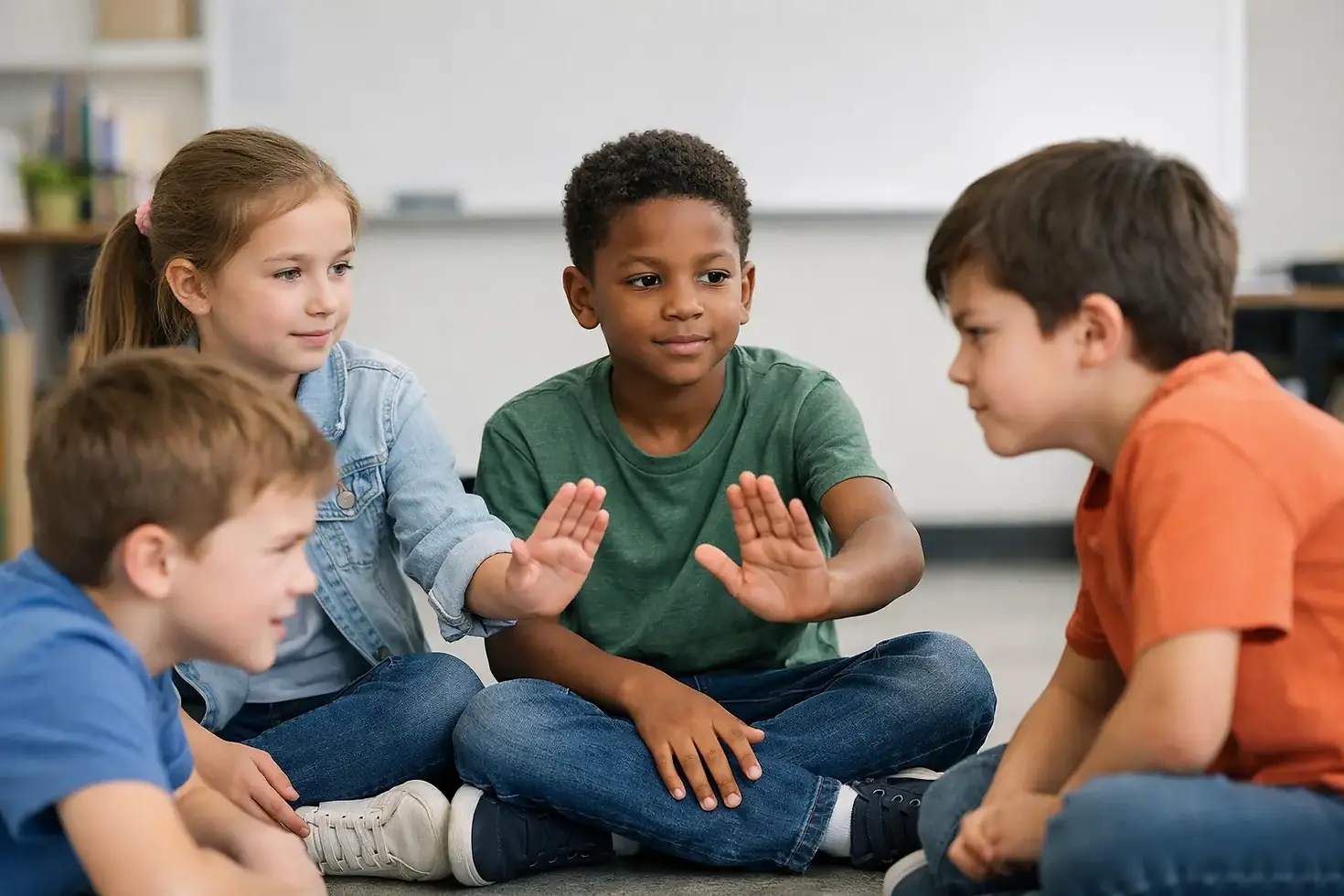
How Kids Learn Conflict Deescalation
- GMA Professor Konrado
- May 18
- 5 min read
A disagreement between kids rarely starts with a big dramatic moment. More often, it begins with a look, a shove in line, a toy grabbed too fast, or a comment that lands the wrong way. Parents see the explosion and wonder what happened. The real answer often starts earlier - and it explains a lot about how kids learn conflict deescalation.
Children do not usually learn calm responses by being told once to "use your words." They learn it through repetition, structure, and example. They need to see what self-control looks like, feel it practiced in safe settings, and build enough confidence that they do not default to panic, anger, or shutdown when tension rises.
How kids learn conflict deescalation in real life
Conflict deescalation is the ability to lower tension before it turns into a bigger problem. For kids, that can mean recognizing when they feel upset, pausing before reacting, speaking with respect, creating space, asking for help, or walking away when needed. It is not passive behavior, and it is not weakness. It is controlled behavior.
That matters because many children only see two options when conflict starts. They either come in too aggressively, or they freeze and give up their voice completely. Neither response sets them up well at school, on the playground, or later in life.
Kids learn deescalation best when adults treat it as a skill, not a personality trait. Some children are naturally more easygoing. Others are more intense, impulsive, or sensitive. But every child can improve with coaching. Just like balance, coordination, or reading social cues, this gets better with consistent practice.
It starts with what kids see at home
Children study adult behavior closely. If they regularly see adults interrupt, raise their voices, or escalate every disagreement, they absorb that pattern. If they see calm correction, steady boundaries, and respectful communication, they absorb that too.
This does not mean parents have to be perfect. It means repair matters. When adults say, "I was frustrated, and I should have handled that better," kids learn that self-control includes accountability. That lesson is powerful because it teaches them that mistakes do not define them. What they do next matters.
Tone is often more important than words. A child can hear the phrase "calm down" as criticism if it comes with frustration behind it. But if an adult models a steady voice, controlled posture, and clear direction, the child gets a real example of deescalation in action.
Kids need practice before they need the skill
One of the biggest mistakes adults make is waiting until a child is already upset to teach conflict management. That is like trying to teach swimming in the middle of a storm. Skills need to be built when the child feels safe and regulated.
Role-playing helps. So do simple conversations after school or after a tough social moment. A parent might ask, "What were you feeling right before you got mad?" or "What could you say next time before it gets bigger?" Those small talks build awareness. Awareness is where deescalation begins.
Children also benefit from scripts. Not robotic lines, but simple phrases they can reach for under pressure. "I don't like that." "Back up, please." "I'm not arguing." "Let's get a teacher." These responses give kids something practical to do when emotions start rising.
Confidence changes how children respond
A child who feels helpless is more likely to overreact. Sometimes that looks like yelling, hitting, or insulting. Other times it looks like nervous laughter, silence, or going along with bad behavior just to avoid conflict. In both cases, the issue is not only emotional regulation. It is a lack of confidence.
That is why structured activities can make such a difference. When children build posture, awareness, and self-control in a disciplined setting, they often become less reactive in daily life. They do not feel the same need to prove themselves. They also become more comfortable with boundaries.
In martial arts, students practice listening under pressure, controlling their bodies, respecting partners, and stopping when instructed. Those habits transfer. A child who learns to breathe, reset, and respond with control on the mat is building skills that help in the classroom and on the playground too.
How martial arts supports conflict deescalation
Parents sometimes assume self-defense training makes kids more aggressive. In a quality school, the opposite is usually true. Good instruction teaches children that strength and control belong together.
Students learn that the goal is not to win every argument. The goal is to stay safe, stay composed, and make smart decisions. That includes using their voice, keeping distance, and knowing when to get an adult involved. Physical technique has a place, but only after avoidance, awareness, and verbal boundaries have been respected.
This matters especially for kids dealing with bullying. A child who has never practiced pressure may panic when someone gets in their face. A child who has trained in a structured environment is more likely to recognize the moment, hold posture, speak firmly, and avoid feeding the conflict. That kind of calm presence can stop many situations before they become physical.
At a family-centered academy like GMA Team, this training works best because children are not just corrected when they make mistakes. They are coached. They are held to standards, but they are also supported. That combination helps kids develop real discipline instead of fear-based compliance.
Not every conflict should be handled the same way
This is where nuance matters. Deescalation is not always talking it out. Sometimes the right move is to apologize. Sometimes it is to set a boundary. Sometimes it is to leave. Sometimes it is to get a trusted adult immediately.
Age matters too. A six-year-old and a thirteen-year-old will not manage conflict the same way. Younger children need shorter directions and more adult guidance. Older kids can handle more responsibility, but they still need tools for peer pressure, sarcasm, social media drama, and status-based conflict.
Personality also matters. A loud child may need help slowing down. A quiet child may need help speaking up sooner. Effective coaching does not force every child into the same style. It helps each child become more controlled, more confident, and more aware of their choices.
What parents can reinforce every week
The best progress usually comes from simple, repeatable habits. Kids do well when the expectations stay clear. Respectful tone, calm hands, eye contact, and asking for help are not one-time lessons. They are family standards.
It helps to praise the process, not only the outcome. If your child walked away from an argument before it got worse, that is worth noticing. If they told a teacher instead of taking revenge, that matters. If they used a firm voice instead of an emotional one, that is growth.
At the same time, children should know that being kind does not mean being a pushover. They can be respectful and still be strong. They can avoid a fight and still protect themselves. They can disagree without losing control.
How kids learn conflict deescalation over time
The honest answer is that they learn it slowly. There is no single talk, class, or consequence that suddenly makes a child skilled at handling conflict. Growth happens through repeated correction, good examples, and opportunities to try again.
A child may do well for two weeks and then have a rough day. That does not mean the lesson failed. It means the lesson is still being learned. Under stress, kids fall back on habits. Our job is to help better habits become the default.
When families and instructors work together, children get a stronger foundation. They hear the same message in more than one place: stay respectful, stay aware, use your words, keep your composure, and choose the safest response available. Over time, that consistency becomes character.
The goal is not to raise kids who never face conflict. It is to raise kids who do not get controlled by it.


Comments